Asian News, Unslanted

New Cold War proxy conflict brewing in Myanmar​


By any measure, it would be a stretch to say that the United States is currently engaged in a New Cold War proxy war with China and Russia in Myanmar.

But as the conflict between the State Administration Council (SAC) junta and a proliferating array of ethnic and political resistance armies escalates, the rivalry between the world’s two big blocs could yet determine the outcome of Myanmar’s increasingly vicious civil war.

On one side, the US is supporting the anti-coup National Unity Government (NUG) and by extension its affiliated People’s Defense Forces armed groups scattered across the country. On the other, China and Russia are more clearly, although not always overtly, in the junta’s camp.

Read More Here
https://asiatimes.com/2024/05/new-cold-war-proxy-conflict-brewing-in-myanmar/
 

New Cold War proxy conflict brewing in Myanmar​


By any measure, it would be a stretch to say that the United States is currently engaged in a New Cold War proxy war with China and Russia in Myanmar.

But as the conflict between the State Administration Council (SAC) junta and a proliferating array of ethnic and political resistance armies escalates, the rivalry between the world’s two big blocs could yet determine the outcome of Myanmar’s increasingly vicious civil war.

On one side, the US is supporting the anti-coup National Unity Government (NUG) and by extension its affiliated People’s Defense Forces armed groups scattered across the country. On the other, China and Russia are more clearly, although not always overtly, in the junta’s camp.

Read More Here
https://asiatimes.com/2024/05/new-cold-war-proxy-conflict-brewing-in-myanmar/
Nigga posts 2 year old new news.
 
That fucking title.
 

Attachments

  • wheeze-laugh.gif
    wheeze-laugh.gif
    176.5 KB · Views: 11

'Could Resonate Globally': Korea Sparks Market Chaos With 'AI Tax' Threat​

sauce

Korean markets were under pressure overnight after politicians floated the idea of tapping AI profits.

Bloomberg reports that a top South Korean policymaker said the nation should pay citizens a 'dividend' using taxes on AI profits, with the obvious read through to Samsung and SK Hynix.

The comments in a Facebook post by presidential policy chief Kim Yong-beom fueled sharp swings in Korean stocks on Tuesday as investors struggled to parse the scope of the proposals.

“Excess profits in the AI era are, by nature, concentrated,” Kim wrote.

Memory companies, core engineers and asset holders in Seoul are highly likely to receive substantial benefits, while much of the middle class may experience only indirect effects, he said.

The size of any potential dividend, and other details on how Kim’s proposals might be implemented, weren’t immediately clear.

The episode is the latest example of politicians calling attention to how the advent of AI risks widening the gap between the haves and have-nots.

While Kim’s ideas are preliminary, if they were to be rolled out it would mark one of the first concerted government efforts to share the proceeds of the boom.

As Goldman's One-Delta desk-head, Rich Privorotsky, noted this morning, this feels like a theme that could resonate globally given the extreme concentration of AI earnings and the fact that the benefits skew so disproportionately to mega cap winners.
 

'Could Resonate Globally': Korea Sparks Market Chaos With 'AI Tax' Threat​

sauce

Korean markets were under pressure overnight after politicians floated the idea of tapping AI profits.

Bloomberg reports that a top South Korean policymaker said the nation should pay citizens a 'dividend' using taxes on AI profits, with the obvious read through to Samsung and SK Hynix.

The comments in a Facebook post by presidential policy chief Kim Yong-beom fueled sharp swings in Korean stocks on Tuesday as investors struggled to parse the scope of the proposals.

“Excess profits in the AI era are, by nature, concentrated,” Kim wrote.

Memory companies, core engineers and asset holders in Seoul are highly likely to receive substantial benefits, while much of the middle class may experience only indirect effects, he said.

The size of any potential dividend, and other details on how Kim’s proposals might be implemented, weren’t immediately clear.

The episode is the latest example of politicians calling attention to how the advent of AI risks widening the gap between the haves and have-nots.

While Kim’s ideas are preliminary, if they were to be rolled out it would mark one of the first concerted government efforts to share the proceeds of the boom.

As Goldman's One-Delta desk-head, Rich Privorotsky, noted this morning, this feels like a theme that could resonate globally given the extreme concentration of AI earnings and the fact that the benefits skew so disproportionately to mega cap winners.
Good
 
It would be nearly impossible to re-establish the gold standard at this stage, with one exception. Civil war or global war which wipes out all governments, and all governments are "restarted" with clean slates.

"The Great Reset," I fathom is not resetting the west's legers, but the world's. Which I spectulate if they crash the entirety of the worlds ecconomies at the same time the "reset" could "work."

Which may be is the reason why the West is so desperate to collapse Chian, (which is happening) and Russia (which seems more resolute)
 

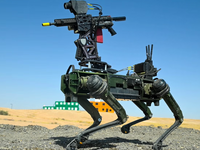
Demographic Winter Pushes South Korea To Field War Robots As Troop Pool Shrinks​

sauce

IMG_2837.png

South Korea's population decline and shrinking pool of military-age men are forcing Seoul to rethink its military force structure, with officials now exploring robots and AI-powered drones to offset future manpower shortages.

South Korea's military is taking a direct page from Ukraine's battlefield playbook by preparing to procure low-cost unmanned aerial systems and robotics for future wars, primarily through a potential partnership with Hyundai Motor - for now.

"Potential deployments include Boston Dynamics' four-legged Spot, the four-wheeled MobED mobility droid, and wearable platforms like the X-ble Shoulder exoskeleton," Bloomberg reported.

South Korea's standing force has slumped 20% over the past six years to about 450,000 troops and is projected to fall to 350,000 by 2040. The demographic winter is already hitting national defense: the population of 20-year-old men has declined by 30% between 2019 and 2025, shrinking the enlistment pool.

IMG_2838.png

Samsung Securities analyst Esther Yim wrote in a note that "robotics is a field without legacy constraints," adding that "these systems can leverage electrical and electronic technologies developed for autonomous vehicles, allowing for rapid proliferation."

For many months, we have outlined how modern warfare is being reshaped by Ukrainian innovation and, more recently, the U.S.-Iran conflict. Ukraine has served as an AI warfare laboratory, accelerating the rise of low-cost drones, ground robots, and, eventually, humanoid warbots.

What's clear: future wars of attrition will mostly be fought with intelligent machines, as manpower-constrained militaries substitute AI drones and ground bots for soldiers on the battlefield.

Beyond Ukraine and South Korea, many other countries are experiencing a demographic winter, characterized by ultra-low fertility, rapid aging, and current or projected population decline.

Here are those countries by region:

East Asia and Southeast Asia

  • South Korea
  • Japan
  • China
  • Taiwan
  • Singapore
  • Thailand

Southern and Western Europe

  • Italy
  • Spain
  • Greece
  • Portugal
  • Germany
  • Austria

Central and Eastern Europe / Balkans

  • Poland
  • Hungary
  • Romania
  • Bulgaria
  • Croatia
  • Latvia
  • Lithuania
  • Moldova
  • Albania
  • Bosnia and Herzegovina
  • Serbia

This suggests that militaries in the countries listed above will be some of the first to prioritize ground bots, drones, and other battlefield robotics as their pools of military-age men continue to shrink. The next weapons stockpiling cycle has already begun as the world fractures into a more volatile and increasingly dangerous environment.
 
Back
Top Bottom