1 In 30 Koreans Margin-Called As Kospi Crashes, Regulator Suspends New Levered ETFs, Hikes Margins
sauce
For the first time in over three years, South Korea’s central bank raised its policy interest rate by 0.25% points to 2.75%, inline with expectations, and kicking off a monetary tightening cycle aimed at containing inflationary pressures spurred by the AI-driven semiconductor boom. It also helped spark a fresh rout in Korean stocks whose daily volatility has become borderline farcical with daily 5% swings having become the norm.
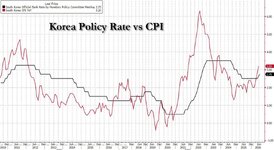
As shown in the chart above,
Korean consumer inflation is running well above the bank’s 2% rate, rising 3.2% in June from a year earlier, its fastest rate since December 2023. The country’s reliance on imported energy has also raised concerns as the conflict in the Middle East has roiled global energy markets.
One reason for the hike was the relentless plunge in the won: despite South Korea’s record current account surplus, the won has remained under pressure, weakening 5% against the dollar year to date to its lowest level since the 2008 global financial crisis and ranking among Asia’s worst-performing currencies.
Analysts blame the currency’s weakness on exporters retaining overseas earnings for reinvestment and overseas equity purchases by Korean institutional and retail investors. The weaker won has pushed up import costs, including for energy. Surging housing prices in Seoul and surrounding areas, coupled with high household debt, are also a concern for Korean authorities.
However, the bigger catalyst behind the latest Korean rout which
sent the Kospi back into bear-market territory after falling about 27% from its June peak, and to the lowest level since April, triggering another set of KOSPI/KOSDAQ sell sidecars in the early-morning...
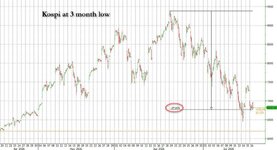
... was
an emergency market monitoring meeting for the Korea's financial regulator, which unveiled measures to curb risks from single-stock leveraged exchange-traded funds, seeking to stabilize a local stock market that has seen wild swings, as individual investors use record amounts of debt to chase profits amid artificial-intelligence-related jitters. (Ed. Note: Koreans do love to gamble)
Most of these ETFs, launched in South Korea in May to track surging and often volatile memory-chip stocks, have been blamed for recent stock-market volatility.
They are largely tied to Samsung Electronics and SK Hynix, which together account for about half of the benchmark Kospi’s market capitalization. 






 tradingeconomics.com

x.com